Childhood Shaped by Tragedy
When we think of rock stars, we often imagine scenes of alcohol, drugs, and recklessness. But Gene Simmons (born Chaim Witz), bassist and one of the founders of Kiss and the man who came up with the band’s name, chose a very different path — largely thanks to his Jewish mother, Flora Klein, a Holocaust survivor, and the traditional upbringing she gave him in childhood.
Holocaust and Survival
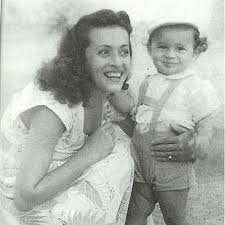
Simmons’s mother, Flora, was born in 1925 in a Hungarian village. In November 1944, she was taken to the Ravensbrück concentration camp. Brutal working conditions, hunger, disease, and constant fear defined her life there. On her clothing, across her back, a white cross was painted as a mark. Flora was liberated from the camp on May 5, 1945.
She rarely spoke about those experiences, and for a long time Gene knew only fragments of her past.
The Birth of Chaim Witz
Gene Simmons was born as Chaim Witz in 1949 in Haifa, Israel. His mother Flora and her brother were the only Holocaust survivors from their family, and they had a profound influence on his worldview and upbringing.
In his early childhood, they lived in Tirat Carmel, Israel, where Gene grew up in a religious Jewish environment.
Emigration to the United States
When he was eight years old, his mother moved with him to New York, USA.
At the age of nine, he briefly studied at Yeshiva Torah Vodaath, a Jewish religious school where he received the basics of religious education. Later he transferred to a public school.
The childhood of the future rock legend was not easy: the family lived in poverty, often surviving only on bread and milk ration coupons. His mother worked hard, and Gene helped from an early age — for example, collecting and selling wild berries and fruit along the roadside.
Upbringing and Inner Foundation
His mother’s camp experience deeply influenced Gene’s upbringing. And his early religious schooling, Jewish identity, and traditions gave him a foundation that, combined with his family history, helped him develop resilience, moral principles, and rejection of destructive patterns.
Poverty, constant need, emigration, and even the change of his name — all this instilled both humility and ambition, as well as the understanding that he had to be “a good boy” not just for himself but for his mother, for her memory.
Mother as a Moral Compass
Gene Simmons often said that his mother remained the most important person in his life, the one who reminded him of who he truly was, even when he wore the mask of a rock star.
The Rolling Stone Interview Story
One of the most touching stories he recalled happened early in his career, when he gave his first major interview to Rolling Stone magazine.
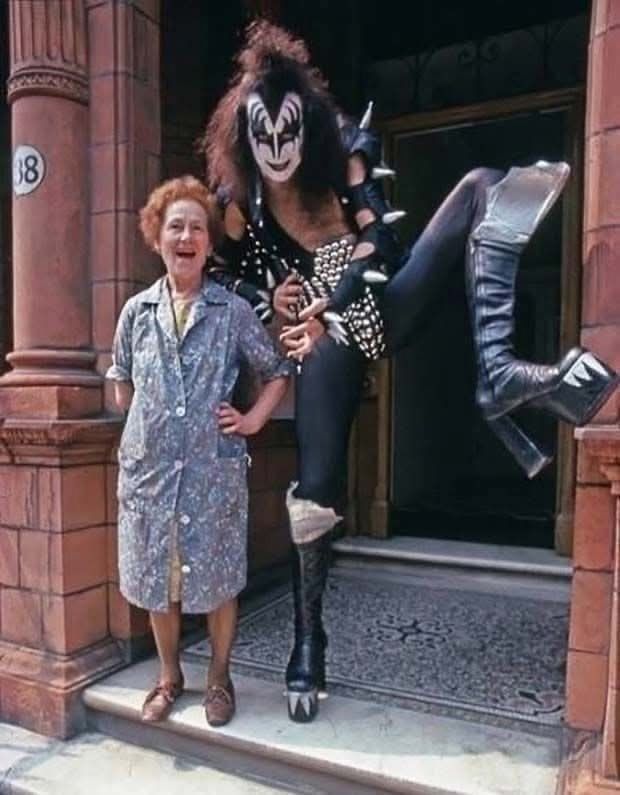
The musician prepared carefully: he wanted to look like a “mysterious demon,” the embodiment of rock and roll. Simmons put on leather pants, heavy silver spider-shaped jewelry, teased his hair to the maximum, painted his nails black, and stood tall on seven-inch platform shoes decorated with dollar signs. He was sure he looked like a dark and enigmatic figure — exactly the image he wanted for the interview.
But everything changed in seconds. The doorbell rang. When Gene opened it, there was his mother, Flora Klein. She didn’t come empty-handed: she brought a real feast — pots of fresh soup, meat cutlets, homemade pancakes, jars of jam, and pies. Enough food to feed not only her son but an entire company. Flora immediately insisted that Gene and the journalist — “hungry boys,” as she called them — sit down and eat. To her, he wasn’t a rock idol in leather pants and high platforms. To her, he was always her son, Chaim. She spoke to him in the Jewish manner, repeating what a “good boy” he was.
Life as Responsibility
The story of Gene Simmons is less about a rock star and more about the responsibility one carries when raised by someone who survived the horrors of history. Flora Klein didn’t just survive — she became a moral compass for her son, shaping the person the whole world now knows.
Mikhail Krasovsky (Czernowitzer Zeitung, Chernivtsi Jewish Newspaper )