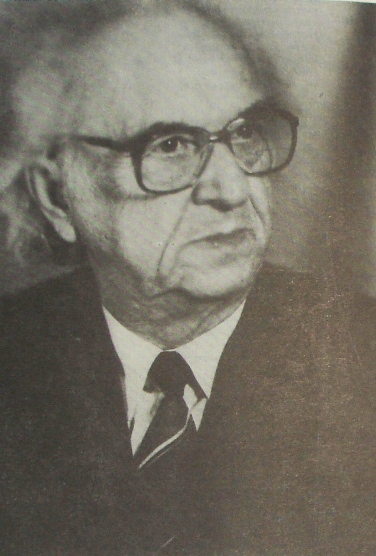
When we speak about Jewish Chernivtsi, we most often remember Paul Celan and Rose Ausländer — poets who wrote in German. But there was another Chernivtsi: a city of Jewish writers who created literature in Yiddish, a city of their newspapers, literary evenings, and intellectual conversations, where this language was not a memory of the past but a living part of everyday life. This world was embodied by Joseph Burg — a writer who lived for almost a century and remained faithful to Yiddish until the very end.
He was born on May 30, 1912, in Vyzhnytsia. When he was twelve years old, Joseph arrived in Chernivtsi and felt as though he had entered an entirely different world. In an interview later recalled by an Austrian radio journalist, Burg said: “When I arrived in Chernivtsi, it was as if I had landed on another planet.” For a boy who had come from Vyzhnytsia, Chernivtsi was a vast, multilingual world. Jews, Ukrainians, Romanians, Germans, and members of other communities lived here. One could hear different languages and encounter people who regarded literature not as a luxury but as an essential part of life.
Joseph Burg wanted to study. His parents, ordinary working people, had more practical ideas about their son's future: he needed to learn a trade in order to earn a living. But the young man dreamed of becoming a teacher, read extensively, and began writing at an early age. Two Jewish literary figures had a decisive influence on him: Eliezer Steinbarg, famous for his fables, and Itsik Manger, a poet and ballad writer. Meeting them helped Burg understand that literature in Yiddish was not something secondary, but a fully fledged creative path.
In his radio essay, Joseph Burg recalls pre-war Chernivtsi with particular tenderness. It seems that he is asking listeners not to reduce the city's Jewish culture to those writers who wrote in German. His recollections convey a powerful idea: Chernivtsi was not merely a city with a large Jewish community — it was an important centre of Yiddish culture.
Burg recalled that before the war, nearly forty writers working in this language lived in the city. Among them were Steinbarg and Manger, as well as many other authors whose names are much less familiar today. Imagine that a hundred years ago in Chernivtsi, one could not only read books in Yiddish but also meet their authors in the street, at an editorial office, or at a literary evening. For Burg, this was not a romantic myth but his own youth.
Yet he was painfully aware of how little remained of that world. In the radio essay, his words sound like the testimony of someone who had witnessed the disappearance of an entire cultural environment: once, numerous Jewish writers had been part of the city, but now he himself had become one of its last representatives.
One of the most fascinating episodes in his biography is connected with the newspaper *Tšernowitzer bleter*. In 1934, Joseph Burg's first short story, “At the Timber Rafting”, was published there. For a young author, this was an important milestone: his writing had found its own place in the city's cultural life. However, the political situation was becoming increasingly dangerous. Jewish culture was subjected to discrimination, and at the end of 1937, the Romanian authorities finally banned and shut down the newspaper.
Then, in 1990, after more than half a century of silence, Burg revived *Tšernowitzer bleter*. Imagine: a man who had survived war, persecution, and many years of forced separation from his hometown once again set out to restore a Jewish newspaper. The publication was modest — just four pages. It could no longer bring back the pre-war literary world, but it made it possible to continue a tradition that history had almost brought to an end. The newspaper became a kind of bridge between Chernivtsi of the past and those who still remembered its voice in Yiddish.
Between 1935 and 1938, Joseph Burg studied German philology at the University of Vienna. There, he lived among Jewish writers and continued to develop as an author. But in 1938, Austria was annexed by Nazi Germany. When the persecution and deportation of Jewish families began, Burg left Vienna and returned to Bukovina. In 1939 and 1940, two collections of Joseph Burg's short stories were published in Bucharest: *On the Cheremosh* and *Yad*.
The next chapter of his life became even harsher. In 1940, Northern Bukovina was occupied by the Soviet Union. Burg accepted Soviet citizenship and even pursued postgraduate studies in Moscow. However, in the summer of 1941, German and Romanian troops advanced towards Chernivtsi. Realising the mortal danger posed by the Nazi genocide, Burg managed to evacuate deep into the Soviet Union. He survived the war in the Volga region and Uzbekistan, particularly in Samarkand, where he worked as a teacher. Meanwhile, in Chernivtsi, the Nazis were destroying his community and his family — and with them, the very environment in which Yiddish culture had flourished.
Joseph Burg spent approximately eighteen years away from Chernivtsi. He spoke about this period without embellishment. In another radio programme, his words were quoted as follows: “Good years and terribly bad years. I don't want to remember that time. They were the hardest years of my life.” After the war, he tried to return to Bukovina, but Stalinism launched a campaign against so-called “cosmopolitans”. The Soviet authorities closed Jewish theatres, newspapers, and publishing houses, and in 1952, leading figures of Jewish culture associated with the Jewish Anti-Fascist Committee were executed in Moscow. Creating literature in Yiddish had become a deadly risk. Burg was forced to move to the Russian provinces — first to the Urals and later to the Caucasus, where for many years he taught German and foreign literature at teacher-training institutes, concealing his talent as a writer.
He was finally able to return permanently to Chernivtsi only in 1959. But returning to the city did not mean returning to its former cultural life. For the writer, it meant that he had lost not only many of his contemporaries. He had lost an entire world in which his language could be spoken freely. One of Burg's most striking statements concerns what actually makes a writer Jewish. He expressed his position clearly: “A Jewish writer is someone who writes in Yiddish. Or in Hebrew. We are a bilingual people.” This was not a denial of the work of Jewish authors who wrote in German, Russian, or other languages. Burg himself had studied German philology and knew the literary traditions of German-speaking Europe exceptionally well. But for him, language was not merely an instrument of writing — it carried memory, experience, and a particular way of seeing the world. That is precisely why he insisted so strongly on the independence and significance of Yiddish literature.
If we remember the Jewish culture of Chernivtsi only through Celan and Ausländer, we may unintentionally overlook another part of its heritage: the writers who addressed their readers in Yiddish and created their own literary tradition in that language. Burg wanted this tradition to remain part of the city's history.
The radio essay also contains a painful discussion about the future of the language. Burg made no attempt to downplay the catastrophe of the Holocaust: among those murdered were millions of Jews for whom Yiddish was their mother tongue. The destruction of these people also meant the destruction of family memories, books, customs, and the environment in which the language had been passed down to children. Yet Burg refused to accept the idea that Yiddish was doomed to disappear. He saw new books being published, writers continuing their work, and young people outside the traditional Jewish world beginning to study the language. His response was filled with hope: a language that had produced literature of worldwide significance does not simply vanish without a trace. He believed that Yiddish would continue to live — albeit in a different world, with different readers and new possibilities.
This conviction is particularly remarkable when we remember that Joseph Burg himself became a living witness to the almost complete disappearance of the cultural environment that had shaped him. It was only in old age that he received widespread recognition as a writer. He was once again able to publish books in Yiddish, his work attracted interest abroad, and people travelled to Chernivtsi to hear his stories. But fame could not bring back his lost friends, pre-war readers, or literary colleagues.
In another radio programme, Burg explained that if he had died before 1980, only a few lines about him would have appeared in a dictionary of Jewish literature. This statement is a bitter testimony to how late his voice began to reach a wider audience.
Joseph Burg died in Chernivtsi on August 10, 2009, at the age of 97. He was buried in the Alley of Honourable Citizens. He remains in history as one of the best-known Jewish writers associated with Bukovina.
Why is Burg's story particularly important for Chernivtsi? Because it reminds us that the city's Jewish history is not only a history of tragedy, nor is it limited to the biographies of a few internationally renowned poets. It is also the history of an everyday language, small newspapers, teachers, editors, and writers who sought to preserve their culture even when there was almost no room left for it.
Joseph Burg could not bring back pre-war Chernivtsi. But he managed to revive a newspaper, write books in his own language, and leave behind a testimony to a world that might otherwise have disappeared from memory. And perhaps this is the most powerful aspect of his story: he remained faithful to his language even when the world around him repeatedly tried to silence him.
Prepared by Mykhailo Krasovskyi, Czernowitzer Zeitung, the Jewish newspaper of Chernivtsi