How Jews Changed Chernivtsi - and How the City Changed Its Jews
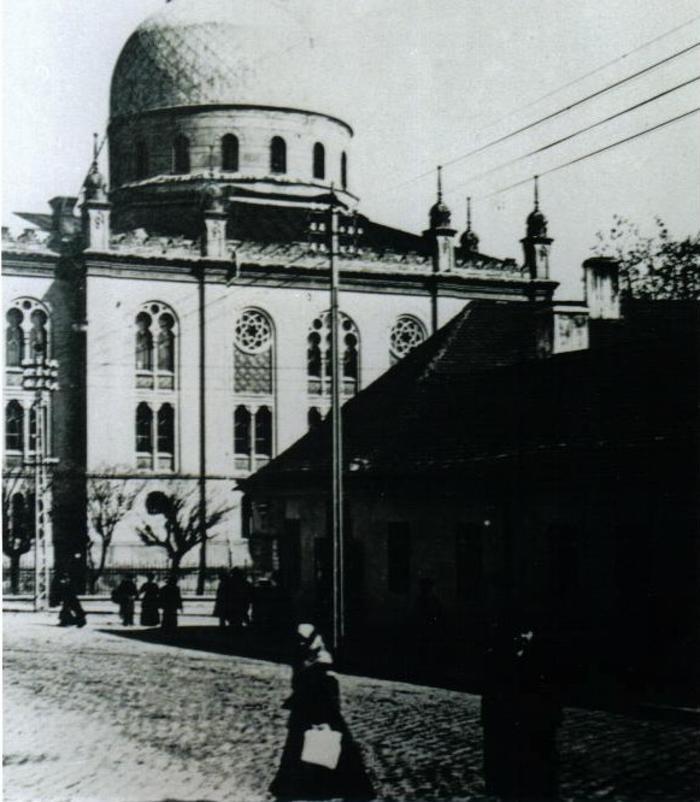
To imagine Chernivtsi at the beginning of the twentieth century simply as an “Austrian city” is to see only half the picture. German could be heard in the streets, but increasingly so could Yiddish. Jewish representatives played a significant role in the city council: at the beginning of the twentieth century, they held 20 of its 50 seats. Jewish entrepreneurs and employees worked in shops and offices, while Jewish professionals worked in hospitals and at the university. Synagogues were active, as were Jewish institutions - schools, associations, and charitable organizations. People debated religion, politics, Zionism, socialism, and the future of Jewish culture. This was not the story of a small, isolated ethnic community. It was the story of a major urban community that, over several decades, became one of the important forces shaping the character of Chernivtsi.The first known written reference to Jews in Chernivtsi dates to 1408. During the sixteenth and seventeenth centuries, the city's Jewish population grew. Jews were primarily engaged in trade, while the community maintained its own kahal, a form of communal self-government with judicial and administrative functions. Yiddish was the principal language of the Jewish population. The urban world that we now associate with Austrian Chernivtsi did not yet exist. The turning point came in the eighteenth century. In 1774, Bukovina came under Habsburg rule. That same year, the Austrian administration counted 468 Jews in Chernivtsi - the largest concentration of Jewish residents in the surrounding district. For the Jewish community, a long and complicated journey toward the modern city was beginning. It was not a straightforward process. Jews gained new opportunities, but those opportunities came with new demands: education, knowledge of German, integration into urban society, and participation in secular institutions. Some members of the community saw this as a path toward equality. Others feared that gaining new rights would mean losing their traditional way of life. This tension would later become one of the central themes of Jewish history in Chernivtsi.During the nineteenth century, Chernivtsi grew rapidly. So did its Jewish community. According to YIVO, 4,678 Jews lived in Chernivtsi in 1850; by 1910, their number had grown to more than 28,000. This was already a very different kind of community. Jews gradually moved beyond traditional commerce. They became entrepreneurs, doctors, lawyers, craftsmen, bankers, and civil servants. They acquired property, established businesses, and joined professional organizations. And they were not simply living in Chernivtsi - they were increasingly helping to build the city alongside its other residents. The process accelerated after the revolutions of 1848 and the reforms of the Habsburg monarchy. In 1867, Jews in Austria-Hungary received civil equality. For Chernivtsi, this marked an important stage in the transformation of the Jewish population into a full part of urban society. But modernization also raised a new question: how could one remain Jewish in the modern world?Part of the Jewish bourgeoisie increasingly adopted German and oriented itself toward German culture. For them, German was the language of education, professional advancement, and urban prestige. These changes reached even into the synagogue. In 1853, Eliezer Igel became Chief Rabbi of Chernivtsi. He preached in German and remained in office until 1892. His work was associated with the modernizing and reform-oriented direction of Jewish life. But not everyone agreed with this course. The Orthodox part of the community opposed the reforms. In 1872, the Orthodox elected their own rabbi, effectively dividing the community. It was only in 1877 that the conflict was resolved with the mediation of the Austrian authorities. Two worlds had collided in Chernivtsi: the traditional and the modern. Both were Jewish.By the beginning of the twentieth century, the Jewish presence had become so significant that it could no longer be ignored in the city's political life. Eduard Reiss served as mayor from 1905 to 1907, and Salo Weiselberger held the office from 1913 to 1914. Both were Jewish. The significance of this was not simply that Jewish mayors were unusual. More importantly, the Jewish community of Chernivtsi was no longer a community living alongside the city's political institutions. Its representatives were leading the city themselves. One of the central figures of Jewish political life was Benno Straucher. He was a lawyer, politician, member of the Austrian parliament, and, from 1903, head of the Jewish community of Chernivtsi. He represented the Jewish National Party, which sought political representation for Jews as a distinct national community. Yet Jewish Chernivtsi was far from politically uniform. On the contrary, assimilationists, Zionists, socialists, supporters of Yiddish culture, and advocates of Hebrew all argued with one another. In the end, the question “Who are we?” proved no less complicated than the question “What rights do we have?”In the 1890s, Zionism began to spread in Bukovina. In 1897, three delegates from Bukovina took part in the First Zionist Congress in Basel. In 1901, the first Zionist organization in Bukovina was established. At the same time, another process was unfolding - the revival of Yiddish as a language of modern culture. And here Chernivtsi unexpectedly found itself at the center of an international debate. In August 1908, Jewish cultural figures gathered in the city. Among them were prominent writers such as I. L. Peretz, Sholem Asch, Avrom Reisen, Chaim Zhitlowsky, and others. They had not come simply to discuss a language. They had come to discuss the future. From August 30 to September 4, 1908, Chernivtsi hosted an international conference devoted to Yiddish and its role in Jewish life. The initiative came from Nathan Birnbaum, a writer, journalist, educator, and political activist.The question was fundamental. The Jewish people had an ancient sacred language - Hebrew. But millions of Jews in Central and Eastern Europe spoke Yiddish every day. Could the language of everyday life become a language of modern Jewish culture? In Chernivtsi, participants sought a political and cultural answer. There is something deeply revealing about the fact that this debate took place in Chernivtsi - a city where one person might speak Yiddish at home, work in German, live within a Romanian state framework, and hear Ukrainian or Polish spoken nearby. Chernivtsi's multilingualism was not a romantic legend. It was an everyday reality. For the Jewish community, the language question became especially acute in the late nineteenth and early twentieth centuries. German provided access to Austrian education and urban culture. Yiddish remained the language of a large part of the Jewish population and increasingly became a language of literature and political life. Hebrew was associated with religious tradition and later with Zionism. The debate between German, Yiddish, and Hebrew was therefore also a debate about the future. What would it mean to be Jewish in modern Europe? Chernivtsi was one of the places where this question could be seen and heard almost on a single street.The First World War changed the city. Russian forces occupied Chernivtsi three times. Part of the Jewish population left, and not everyone returned after the war. After the collapse of Austria-Hungary, Bukovina became part of Romania. Jewish life did not disappear. On the contrary, during the interwar period, Chernivtsi remained one of the largest centers of Jewish life in the region. The 1930 census recorded more than 42,000 Jews in the city - about 37 percent of its population. It was a very large community. Jewish representatives served on the city council. Jews were active in professional organizations and the Chamber of Commerce and Industry. Several Jews represented Chernivtsi in the Romanian Parliament. At the same time, however, the world they knew was becoming increasingly dangerous. The Romanian authorities intensified their policy of “Romanianization,” particularly in education. Antisemitic attitudes became increasingly visible. In 1930, the majority of Chernivtsi's Jewish population identified Yiddish as their mother tongue. Jews were still one of the city's largest communities. But the time of that world was running out.In June 1940, the Soviet army entered Chernivtsi. For Jews, this did not mean an end to persecution, but a different form of destruction of their established way of life. According to YIVO, around 3,000 members of the Jewish bourgeoisie were deported to Siberia. What had been built over decades - private businesses, property, professional standing, and economic networks - was dismantled under the new Soviet system. But what happened a year later was incomparably more devastating. On July 5, 1941, Romanian and German forces returned to Chernivtsi. Persecution of the Jews began. There were killings, confiscation of property, forced labor, and restrictions on movement. Chief Rabbi Abraham Mark was killed. The Jewish Temple was burned.In October 1941, a ghetto was established in Chernivtsi. Deportations to Transnistria began. According to Yad Vashem, 28,391 Jews were deported from Chernivtsi during the first wave of deportations. The number itself is difficult to comprehend. Behind it were thousands of families. Doctors, shopkeepers, lawyers, workers, writers, children, elderly people - the same residents of the city who only recently had lived in their homes, attended schools, worked in institutions, traded in the streets, and argued about Yiddish and Hebrew. Now they were being driven out of Chernivtsi.There is one name in this story that cannot be overlooked: Traian Popovici. A Romanian Doctor of Law and attorney, mayor of Chernivtsi during the occupation, he opposed the deportation of Jews. He appealed to the Romanian authorities and sought to keep doctors, engineers, lawyers, and members of other professions in the city. Yad Vashem recognized him as a Righteous Among the Nations. At the same time, it is important not to turn this history into a legend about one man who “saved everyone.” Popovici could not stop the system of persecution itself. Deportations continued, thousands of people died, and the Jewish community suffered devastating losses. But his intervention gave many people a chance to survive. On the scale of the catastrophe, this did not erase the crime. But for each person who was saved, it meant everything.After the war, Chernivtsi could no longer return to the life that had existed before 1941. The city's Jewish majority was gone. Families had disappeared. So had businesses, associations, schools, newspapers, and political organizations. The multilingual urban world in which Yiddish had been the everyday language of tens of thousands of people was gone. But memory did not disappear. It remained in archives, old photographs, books, the Jewish cemetery, the recollections of those who survived the deportations, and buildings that had survived the twentieth century. The names remained. Eliezer Igel. Benno Straucher. Eduard Reiss. Salo Weiselberger. Nathan Birnbaum. Eliezer Steinbarg. Abraham Mark. Behind each name is a different story, a different vision of the future, and a different answer to the question of what it meant to be Jewish.Perhaps the most important thing about the history of the Jews of Chernivtsi is not the number of famous people or population statistics, but the fact that for centuries Jews were part of a city that was constantly changing. They entered the history of Chernivtsi as a small community of merchants and craftsmen. They later became entrepreneurs, doctors and lawyers, professors and politicians, mayors. They created schools, hospitals, charitable institutions, newspapers, and cultural societies. This was not the history of a separate world existing somewhere “alongside” the city. Jewish Chernivtsi was part of Chernivtsi itself. Its history is the story of how a small community became one of the important participants in the city's modernization, how it learned to live between tradition and modernity, between Yiddish, German, and Hebrew, between religious and secular life, between local identity and Jewish national ideas. And then that world was almost destroyed in the Holocaust.So when we look at Chernivtsi today, it is worth remembering that behind its beautiful Austrian architecture lies the history of people who lived here, worked here, argued, fell in love, built, studied, wrote books, raised children, and debated the future. Among them were tens of thousands of Jews over the course of several decades. And without them, the history of Chernivtsi would be different.Oleh Khmelnytskyi, Chernivtsi Jewish Newspaper “Czernowitzer Zeitung”
Add your comment