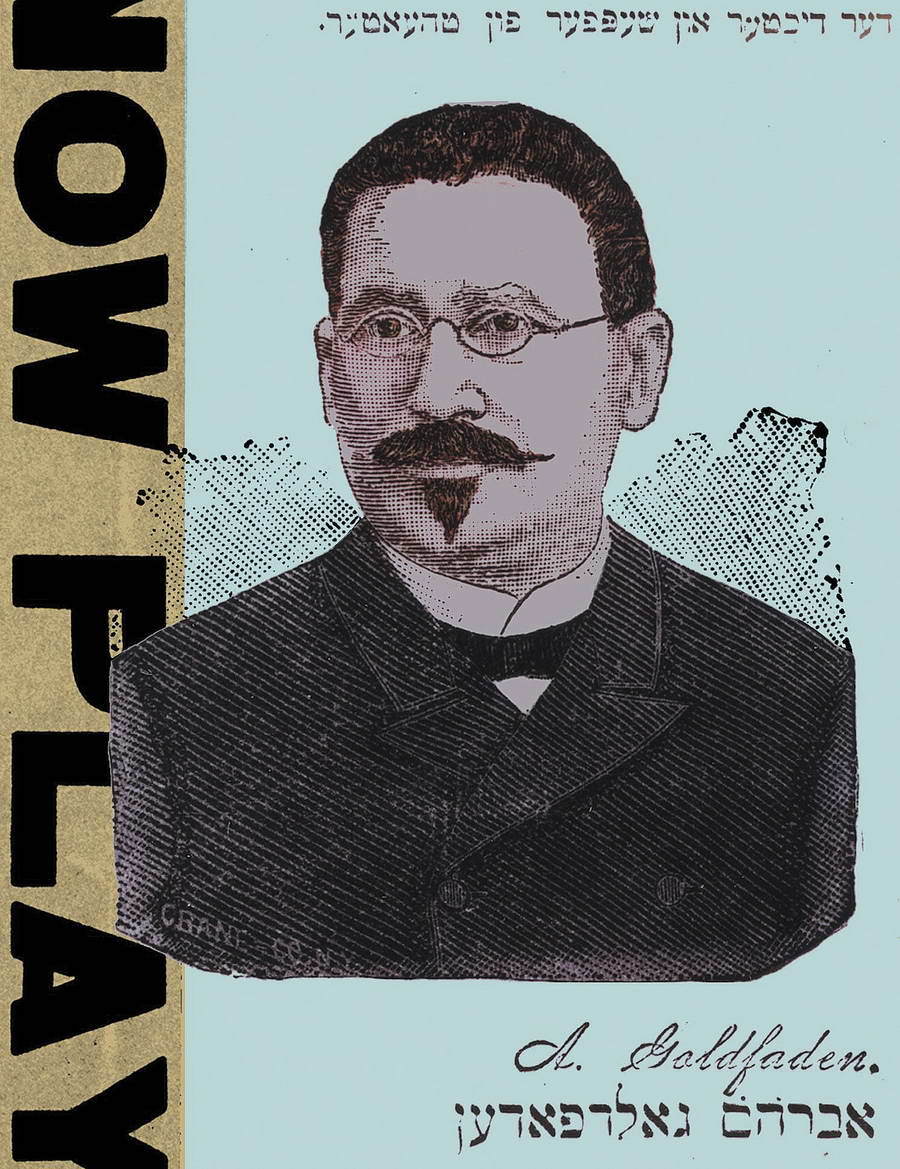
It is well known that Chernivtsi was a “Jewish” city. At various times and in different eras, prominent figures of Jewish culture lived and worked here, including the founder of Jewish theatre Abraham Goldfaden and the classic of Yiddish literature Sholem Aleichem.
It is no coincidence that in 1945 the well-known Kyiv Jewish Theatre was named after the latter; due to various historical circumstances, its troupe eventually found itself in Chernivtsi. In Sholem Aleichem’s work, Chernivtsi occupied a special place. In his novel Wandering Stars, as is known, the main character Leo Rafalesco performed on various stages, including the one in Chernivtsi. After a sold-out performance in Chernivtsi, he and the touring troupe of Jewish actors “Goltzman, Shvalb & Co.” set off for London in search of worldwide recognition…
The mention of Chernivtsi in the novel was natural, as Sholem Aleichem visited the city several times. The first visit took place in 1891, and the second in 1906, at the invitation of the Chernivtsi Jewish student society “Emuna.” However, during his first visit the writer did not like the city, considering it too provincial.
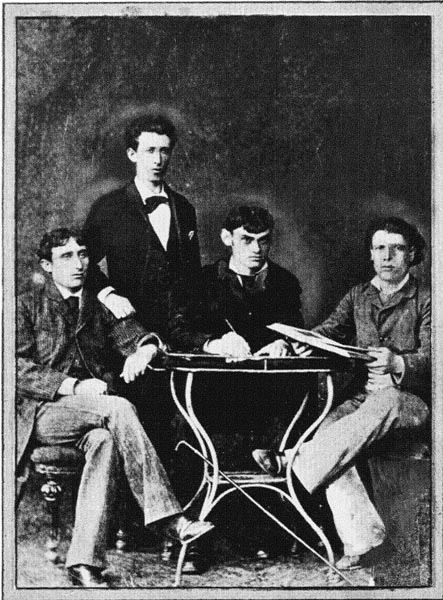
The history of Jewish theatre in Chernivtsi is closely connected with the name of A. Goldfaden, whose work inspired local amateurs to establish a Jewish theatre. “The renowned Jewish playwright and composer Abraham Goldfaden was always a welcome and frequent guest in Chernivtsi,” noted the Chernivtsi newspaper Czernowitzer Tagblatt on 14 January 1908, reporting on the artist’s death in New York. Goldfaden last visited Chernivtsi in 1906 to attend the premiere of a performance based on his play. “Jewish students of Chernivtsi greeted the outstanding poet and composer, who wrote in Yiddish, with warm applause,” the Czernowitzer Tagblatt correspondent reported.
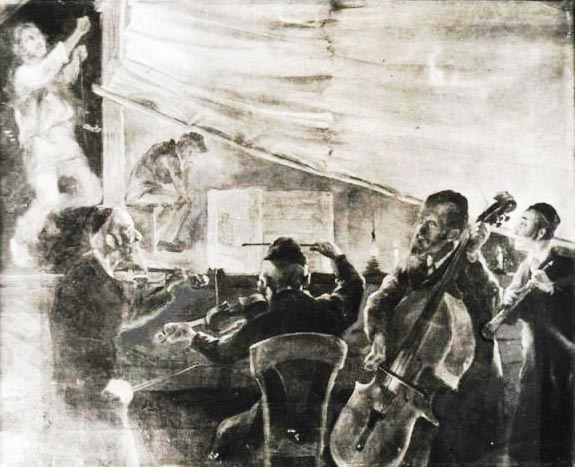
The first Jewish theatre in Chernivtsi was the German-Jewish Theatre, founded in 1877 by the Jewish actor and playwright Moses Horowitz. All performances were staged in Yiddish. Soon the theatre was headed by Abraham Axelrad. The theatre had no permanent premises and performed mainly in city restaurants. Spectators ate, drank, and at the same time enjoyed the actors’ performances, maintaining close contact with them. Events on stage were actively commented on by the audience. Theatre announcements often included the menu of the respective restaurant. The repertoire consisted of plays by A. Goldfaden, J. Lateiner, and M. Horowitz. The theatre enjoyed extraordinary popularity among the Chernivtsi public. At the same time, A. Axelrad sought to maintain the theatre’s reputation at the highest level by inviting only renowned actors to his troupe.
Thus, in 1909 he invited Kalmen Juvelier, who had successfully performed on stages in the United States. In Chernivtsi, the American actor appeared in the plays The Hero of the Army and Kol Nidre based on works by Sigmund Feinman and A. Goldfaden respectively, as well as in Aunt Zipoyra by Joseph Lateiner. In addition, K. Juvelier directed the play God, Man, and Satan based on the work of J. Gordin.
In 1910, A. Axelrad invited the famous playwright and actor, head of the Jewish Theatre in New York, Boris Thomashefsky, for a гастролі (tour). The following year, another American comic actor, Charles Friedman, came to Chernivtsi and played the role of Mykyta in the play Bas Yehide by Naum Rakov. Despite the high ticket prices, audiences of the German-Jewish Theatre were delighted with his performance. Tours by Bernard Jung with The Jewish King Lear (J. Gordin) and by H. Kanapoff with Kol Nidre were also successful.
However, not all invited artists and directors appealed to the demanding Chernivtsi audience. Fierce competition among Jewish theatres in the United States forced many Jewish-American artists to seek additional income through European tours. Obviously, Chernivtsi was not a particularly attractive city for them. In 1912, the German-Jewish Theatre went bankrupt, and many of its actors left the city even before the outbreak of the First World War. At the same time, Axelrad’s troupe in its main composition continued to exist until his death in 1925.
In 1910, the well-known Austrian public and political figure, writer and publicist, and initiator of the First World Conference on Yiddish, Nathan Birnbaum, founded the national-cultural society “Jewish Theatre” in Chernivtsi. According to Birnbaum, a Yiddish-language theatre was of great importance for the national development of Jews and was to become a “center of Jewish culture and education.” The organizers of the Jewish Theatre, among whom was the well-known Chernivtsi lawyer Max Diamant, planned to build a separate theatre building, supported tours by leading actors of the world, advocated for “cleansing” Jewish theatre repertoires of “shund” (“repertoire trash”), and generally sought to transform Jewish theatrical art in Bukovina into a professional field. However, dramatic plays did not arouse much enthusiasm among the broader Jewish public of Chernivtsi. The Jewish theatre remained a place for entertaining comedies and cheerful operettas. Soon, however, a tragedy far from theatrical — the First World War — unfolded in Bukovina, and the plans of the Jewish Theatre had to be abandoned.
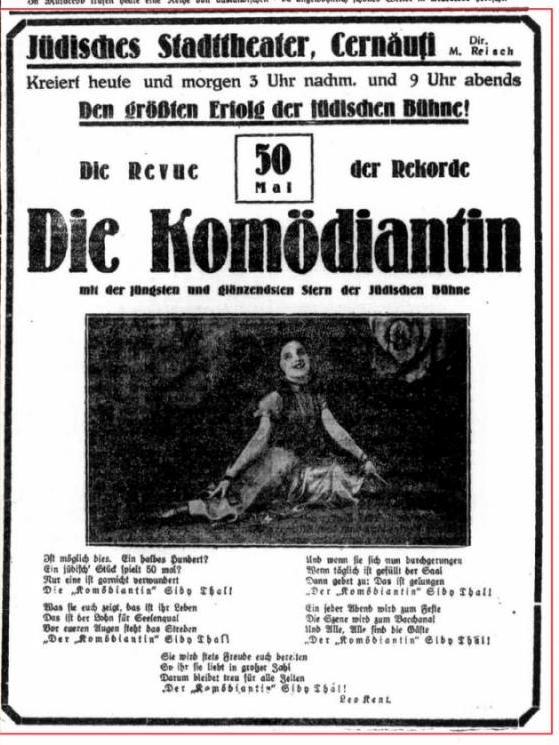
After the end of the war in 1918, the Jewish Pavilion Theatre headed by Max Reisch emerged in Chernivtsi. The theatre was located outdoors, in the courtyard of a building at 22 Ruska Street. Performances took place only in the summer, although Reisch planned to build a separate enclosed theatre building. To this end, he announced a fundraising campaign among spectators and began staging overt “shund” — entertaining, commercially profitable performances. However, in the pursuit of profitability, the theatre lost its regular audience, which did not appreciate the new repertoire.
At the same time, in 1931, Reisch received permission from the city authorities to build another Jewish theatre in the garden of a building at the corner of Doctor-Reisgasse and Beer Palace streets (Mircea Vodă Street, now Ukrainian Street), with the symbolic name “Goldfaden.” Thus, in the 1930s two Jewish theatres operated in Chernivtsi — the Pavilion Theatre and “Goldfaden.”
On the stages of both theatres, Reisch staged plays by A. Goldfaden (Bar Kokhba, The Sorceress, The Sacrifice of Isaac), the opera Between Heaven and Earth by the theatre’s musical director, the renowned Jewish composer Huno Wolfsthal, as well as the political revue Doctor Mandate, by an unknown Chernivtsi author. The premiere of the latter, which took place in 1929 at the Pavilion Theatre, lasted more than five hours.
During the interwar period, various Jewish theatrical studios and societies also developed vigorously in Chernivtsi. An important center for the popularization of Jewish theatrical art in Bukovina was the Jewish School Society, which included well-known Jewish poets, prose writers, and playwrights — I. Manger, J. Sternberg, E. Steinbarg, M. Altman, and others. In 1930, at the Toynbee Hall, Chernivtsi audiences for the first time saw a performance by the small-forms theatre Chameleon, whose stage featured miniatures based on works by Sholem Aleichem, I.-L. Peretz, E. Steinbarg, and I. Manger.
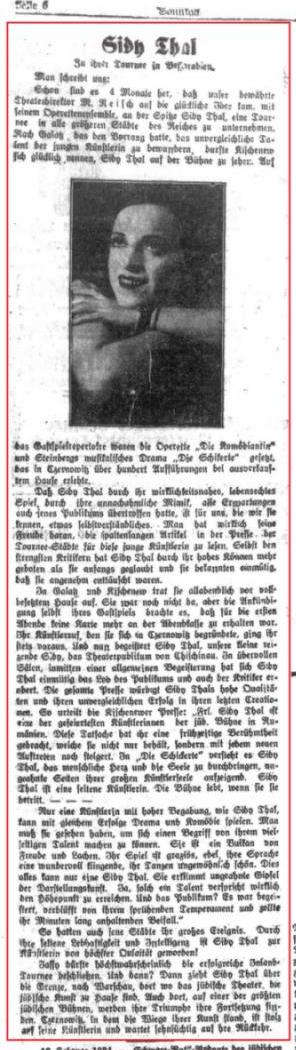
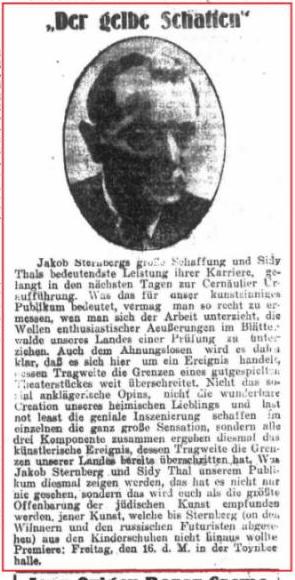
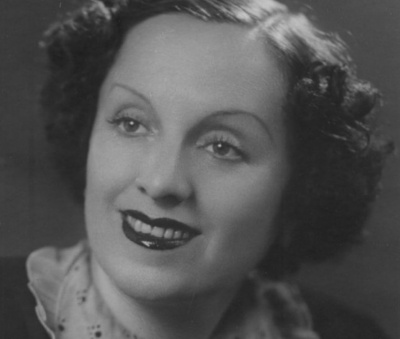
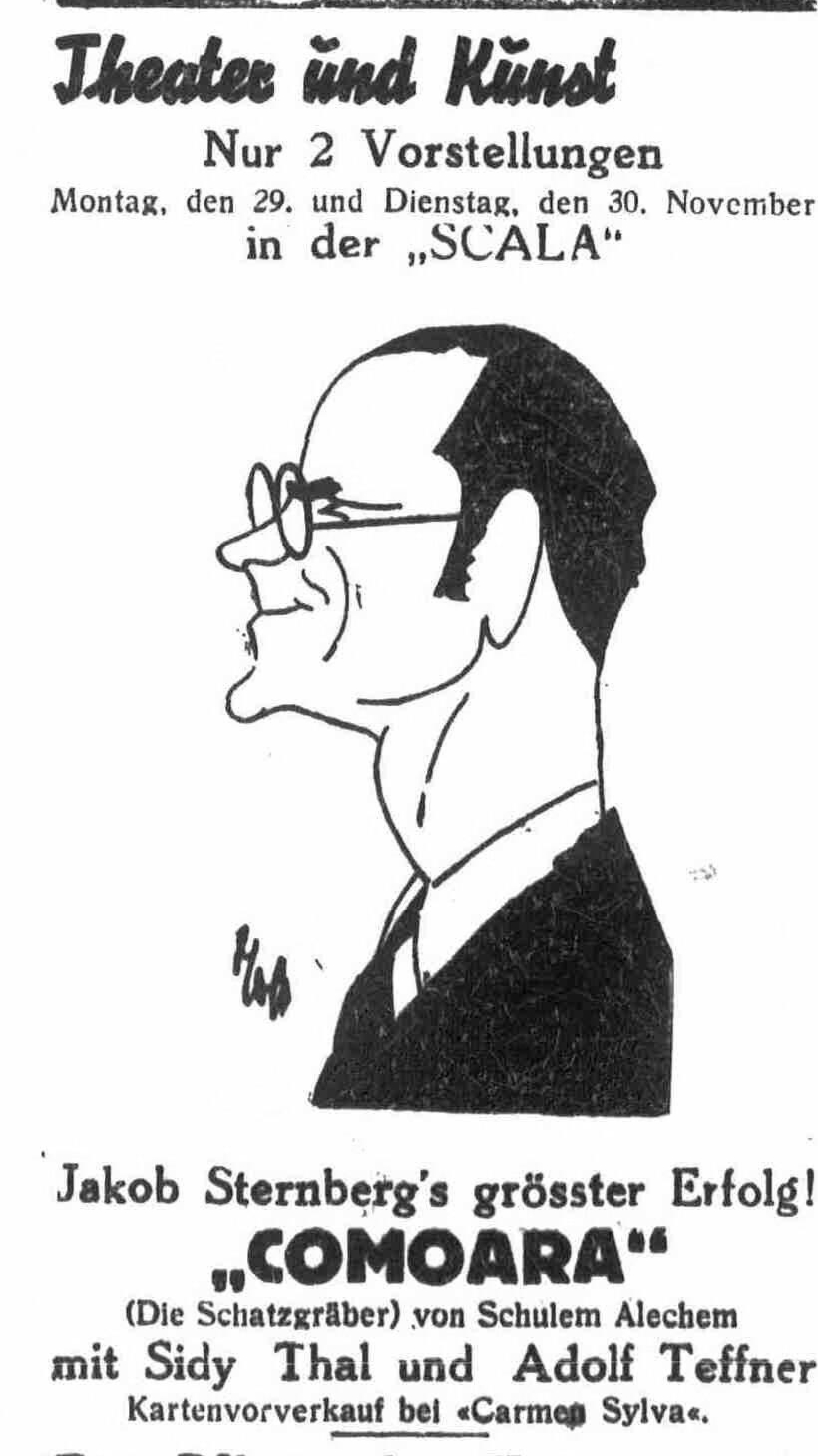
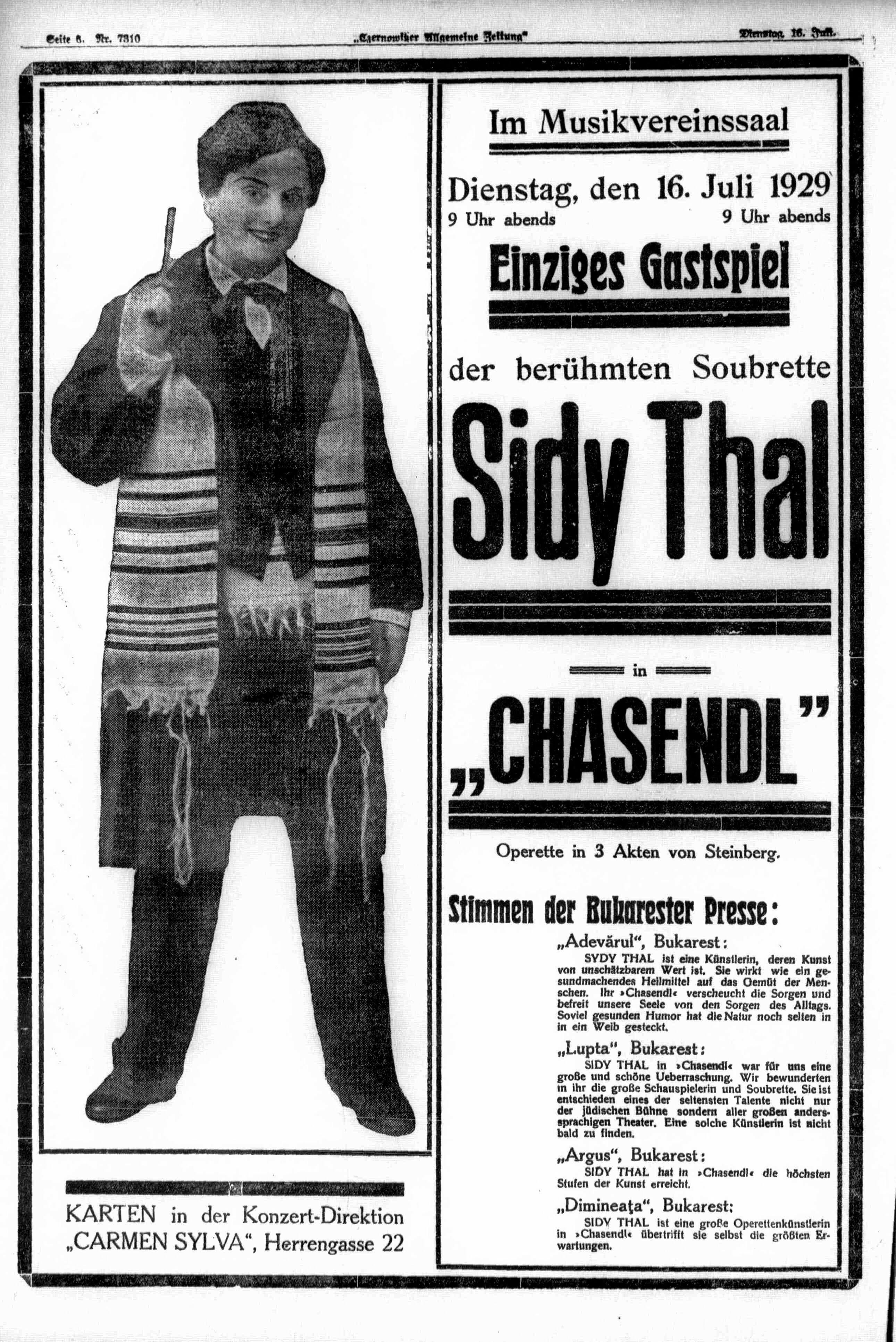
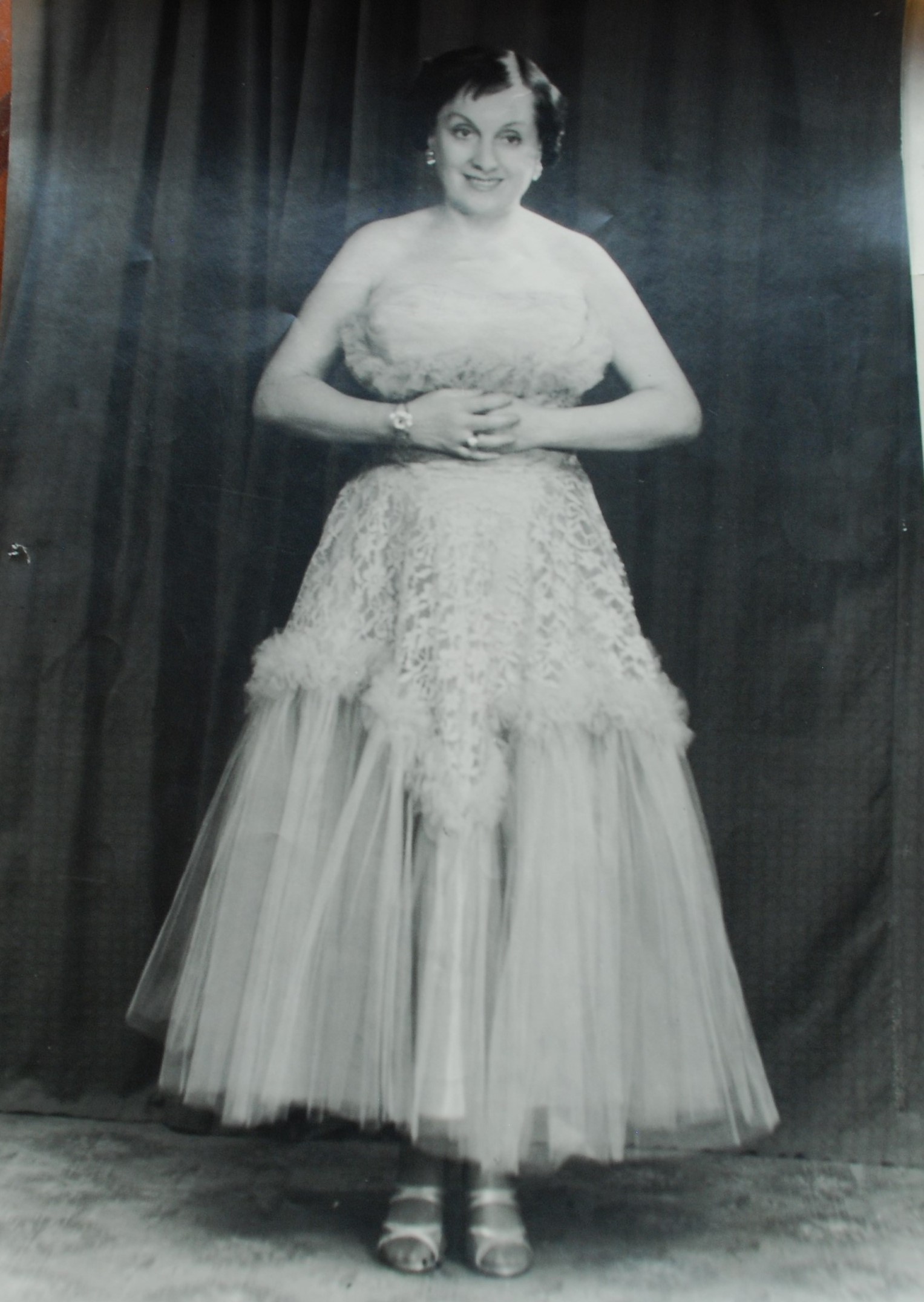
Thus, in the 1930s, Jewish theatre in Chernivtsi became a modern art form primarily thanks to the brilliant talent of the renowned Bukovinian artists Sidi Tal and Adolf Tefner. On 8 November 1936, the premiere of the play The Yellow Shadow of Moloch (directed by J. Sternberg), starring Sidi Tal, took place on the stage of the Scala cinema palace. According to the plot, a Jewish girl, Reizele, arrives in Brazil from Eastern Europe to earn money but, together with other Jewish immigrant women, ends up in a brothel, where she is forced to serve sailors. Only on Yom Kippur do the Jewish prostitutes pray and fast. At the same time, Reizele refuses to celebrate Purim, as she does not observe the religious holidays recognized by the Jewish “madam” of the brothel. After marriage and with the support of her compatriot friend (played by Adolf Tefner), Reizele eventually becomes a respectable Jewish woman, helps her relatives, and makes donations to the poor. Her only goal is to forget her former life as soon as possible. “I want to forget, but the world does not want that…,” the heroine, portrayed by Sidi Tal, said from the stage.
In the late 1930s, antisemitism intensified in Romania, which undoubtedly hindered the full development of Jewish theatrical art, including in Bukovina. The Pavilion Theatre in Chernivtsi became the target of systematic attacks by Romanian nationalists — the “Cuziști,” whose regional center, ironically, was located next to the Jewish Theatre. Some Jewish artists were banned from performing by the local authorities.
After Northern Bukovina became part of Soviet Ukraine in 1940, the State Jewish Traveling Theatre was established in Chernivtsi. It consisted mainly of local actors, many of whom were recognized masters of the Jewish stage: B. M. Rintzler, S. N. Lerer-Lorescu, M. A. Reisch, A. Yu. Stein, K. E. Gottlieb, E. K. Schertzer, E. A. Leibl, E. N. Zilberman, conductor and violinist S. S. Wolfenzon, prompter and writer L. M. Drucker, S. D. Vites, B. A. Tot, D. G. Kronenfeld, F. M. Herbel, M. Kh. Bartfeld, and N. M. Meler. Later, actors from the state Jewish theatres of Kyiv, Baku, and Birobidzhan (known in Russian as GOSET) were invited to join the newly created Chernivtsi troupe. The Chernivtsi Jewish Theatre employed 92 people, of whom 67 were actors and musicians. Leading actors included M. G. Sekler, M. D. Lichtenstein, S. N. Khromchenko, Kh. A. Ostrovsky, L. M. Zholkover, M. Sh. Bernstein, and others.
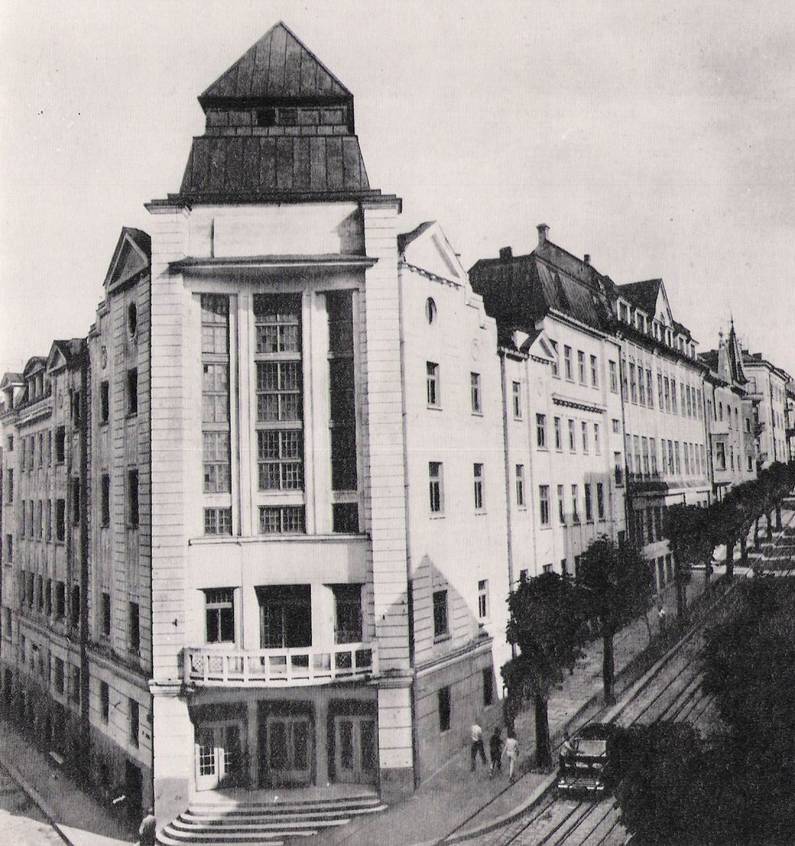
L. Kh. Gazinsky was appointed director of the theatre, although he was soon dismissed. The artistic director was M. L. Nikolaevsky, the chief artist was S. L. Goldberg (formerly of the Birobidzhan GOSET), and the conductor was Ya. N. Vinokur. At the beginning of 1941, the theatre became the stationary Chernivtsi GOSET, officially registered at the Scala cinema palace. In October 1940, the troupe announced the premiere of Sholem Aleichem’s play Two Hundred Thousand. By early 1941, the theatre’s repertoire already included Tevye the Dairyman by Sholem Aleichem, Uriel Acosta by K. Gutzkow, as well as a number of Soviet plays. The new theatre season opened on 1 January 1941 with the premiere of Liberation by V. Orshansky.
However, during the Romanian occupation of Bukovina in 1941–1944, the State Jewish Theatre in Chernivtsi was closed, although some of its former actors later joined the Kyiv GOSET, which was re-evacuated to Chernivtsi in 1945. Nevertheless, as is well known, that was already a completely different story…
Oleksandr Bezarov, Doctor of Historical Sciences,
Associate Professor of World History of Chernivtsi National University
(For more details on the life and work of the Kyiv theatre troupe on the Chernivtsi stage, see: Bezarov O., The Last Sold-Out Performance. The History of the Sholem Aleichem Jewish Theatre (1945–1950)).